


We have never had more tools to help us sleep better, move more, breathe slower and build healthier habits. So why is it still possible to know so much about ourselves and not quite understand how we are doing?
There is a particular kind of morning that has become normal. Before you have properly decided how you feel, your phone or watch has already begun to tell you. You slept for six hours and forty-three minutes. Your recovery is lower than usual. You have taken 612 steps. Yesterday you closed two rings but missed the third. Perhaps another app reminds you to drink water, another tells you that your meditation streak is now twelve days long, and another is waiting for you to log your mood.
None of this is necessarily a bad thing. In fact, much of it can be genuinely useful. A step counter can reveal how little we have moved during a long day at a desk. A sleep tracker can make an irregular routine difficult to ignore. A breathing exercise can interrupt ten minutes of tension before it becomes an entire evening. Habit reminders, prompts, goals and feedback are widely used in digital health because they can help people pay attention to behaviours that otherwise disappear inside the busyness of ordinary life.
The strange part begins when we realise that it is possible to collect all this information and still feel unsure about the simplest question.
How am I actually doing?
The tools were never really the problem
It is easy to criticise wellness apps because there are so many of them. Meditation, sleep, movement, food, mood, heart rate, breathing, habits, screen time. Open an app store and almost every part of daily life has become something that can be measured, improved or reminded.
But the appeal makes sense. Modern life is difficult to see while you are inside it. Days move quickly. Work expands. Sleep slowly shifts later. Movement becomes something we mean to do. A useful tool can make an invisible pattern visible. That can be valuable.
Research into digital health tools reflects this. Many apps use techniques such as self-monitoring, goal setting, prompts, feedback and rewards because these approaches can support behaviour change and engagement. There is nothing inherently wrong with knowing how many steps you walked or when you went to bed.
The limitation is subtler.
Most of these tools have to simplify you in order to be useful.
A sleep app looks at sleep. A movement app looks at movement. A meditation app looks at meditation. A nutrition app looks at food. Each one takes a part of life and brings it closer, rather like a camera zooming in.
The problem appears when the close-up begins to feel like the whole picture.
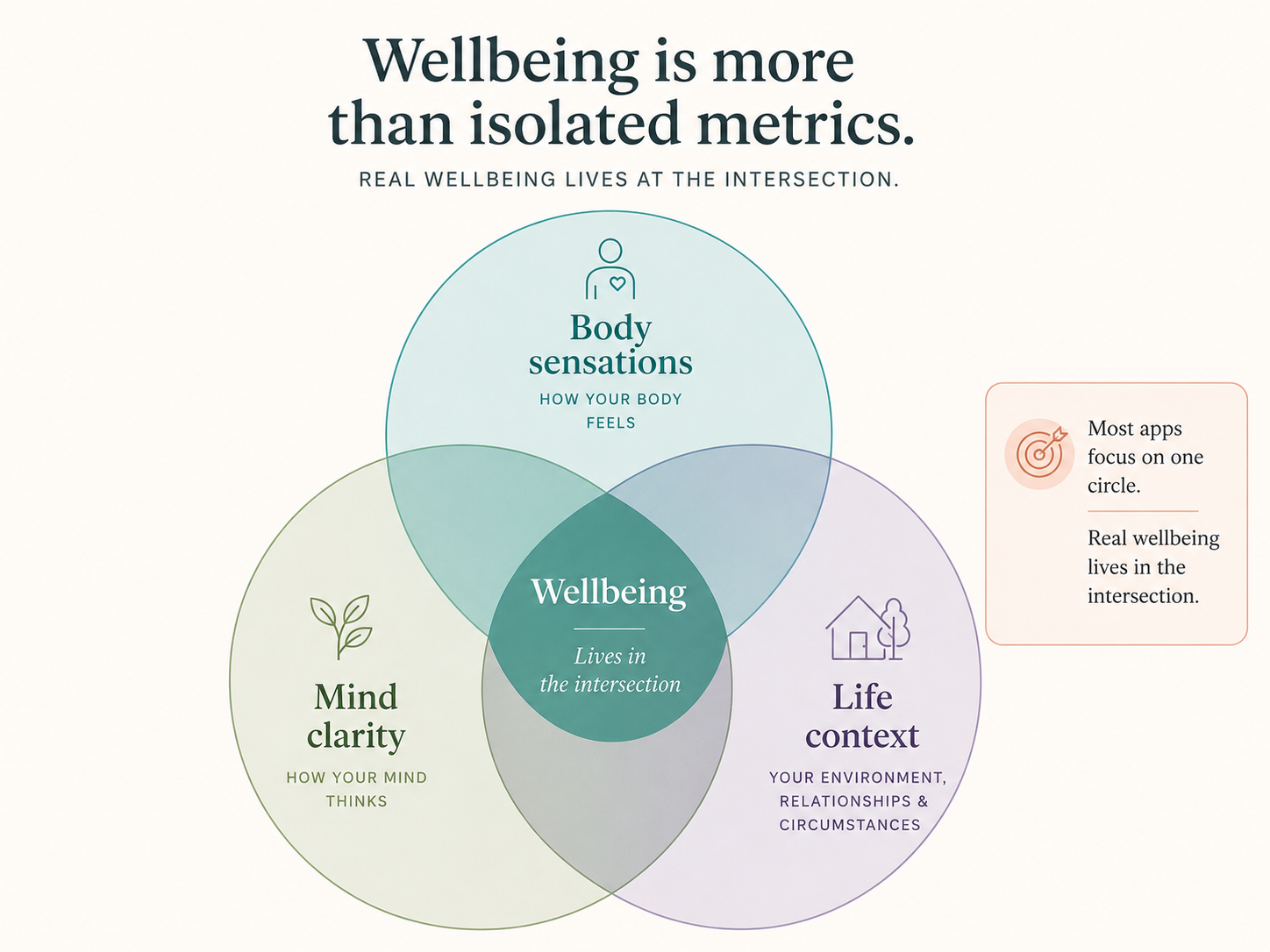
A life does not happen one metric at a time
Wellbeing is difficult to divide neatly because life itself does not arrive in neat categories.
Imagine that you have been sleeping badly. A tracker might notice the shorter duration and tell you that your sleep has declined. That is useful information. But why has it declined?
Perhaps work has been occupying your mind long after the working day ends. Perhaps a relationship has become difficult. Perhaps you have stopped moving as much, and your days now happen almost entirely indoors. Perhaps money has been quietly worrying you. Perhaps nothing dramatic has happened at all, but life has become so crowded that your mind no longer receives a clear signal that the day is over.
The sleep number can show the outcome. It cannot always show the context.
The same is true elsewhere. A person can reach a step target and still feel depleted. They can meditate every morning while feeling disconnected from the people around them. They can eat carefully and still have very little space in their week that feels like their own. Someone can maintain every habit they intended to build and still wonder why life feels thinner than it used to.
This is where wellbeing becomes more interesting than optimisation.
The different parts of a life move together. Sleep changes energy. Energy affects patience. Work enters relationships. Relationships affect the mind. Financial pressure can alter rest. A sense of meaning can change how effort feels. Environment can make movement, attention and recovery easier or harder without us consciously noticing it.
When we monitor only the pieces, we can miss the pattern between them.
Research on self-tracking has found many potential benefits, particularly around awareness, motivation and goal setting. It has also raised important questions about how people interpret their own data, why they disengage from tracking and what happens when self-monitoring becomes psychologically demanding rather than helpful.
The distinction is important.
Measurement can tell you what changed. Understanding asks why.
When looking after yourself becomes another thing to perform
There is another shift that can happen quietly.
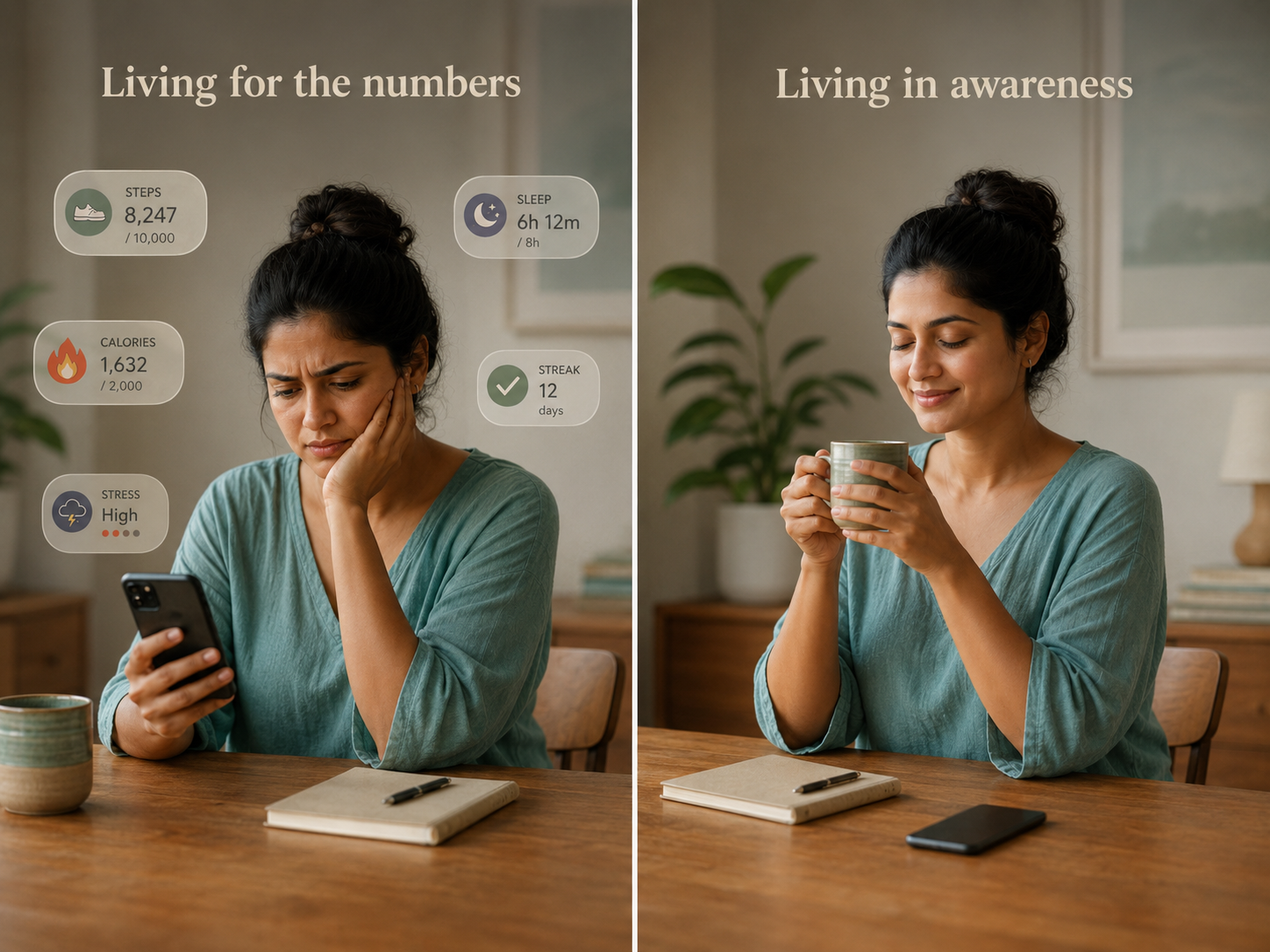
At first, tracking feels supportive. You walk because you wanted to walk, and the number gives you a small sense of progress. You meditate because ten minutes helps you settle, and the streak simply records that you showed up.
Then the relationship can reverse.
You walk because the ring is still open.
You meditate because you do not want to lose the streak.
You sleep badly, see a poor score, and begin the morning feeling disappointed about a night that has already happened.
The tool has not necessarily changed. Your relationship with it has.
For some people this never becomes a problem. They look at the information, take what is useful and move on. But for others, another curious form of pressure appears. Wellbeing becomes one more area in which they can succeed or fail.
There is always another metric available.
Another goal.
Another reminder.
Another week in which you were going to do better.
The irony is easy to miss because all of these things belong to something supposedly good for us.
But there is a difference between caring for yourself and managing yourself.
One can slowly begin to replace the other.
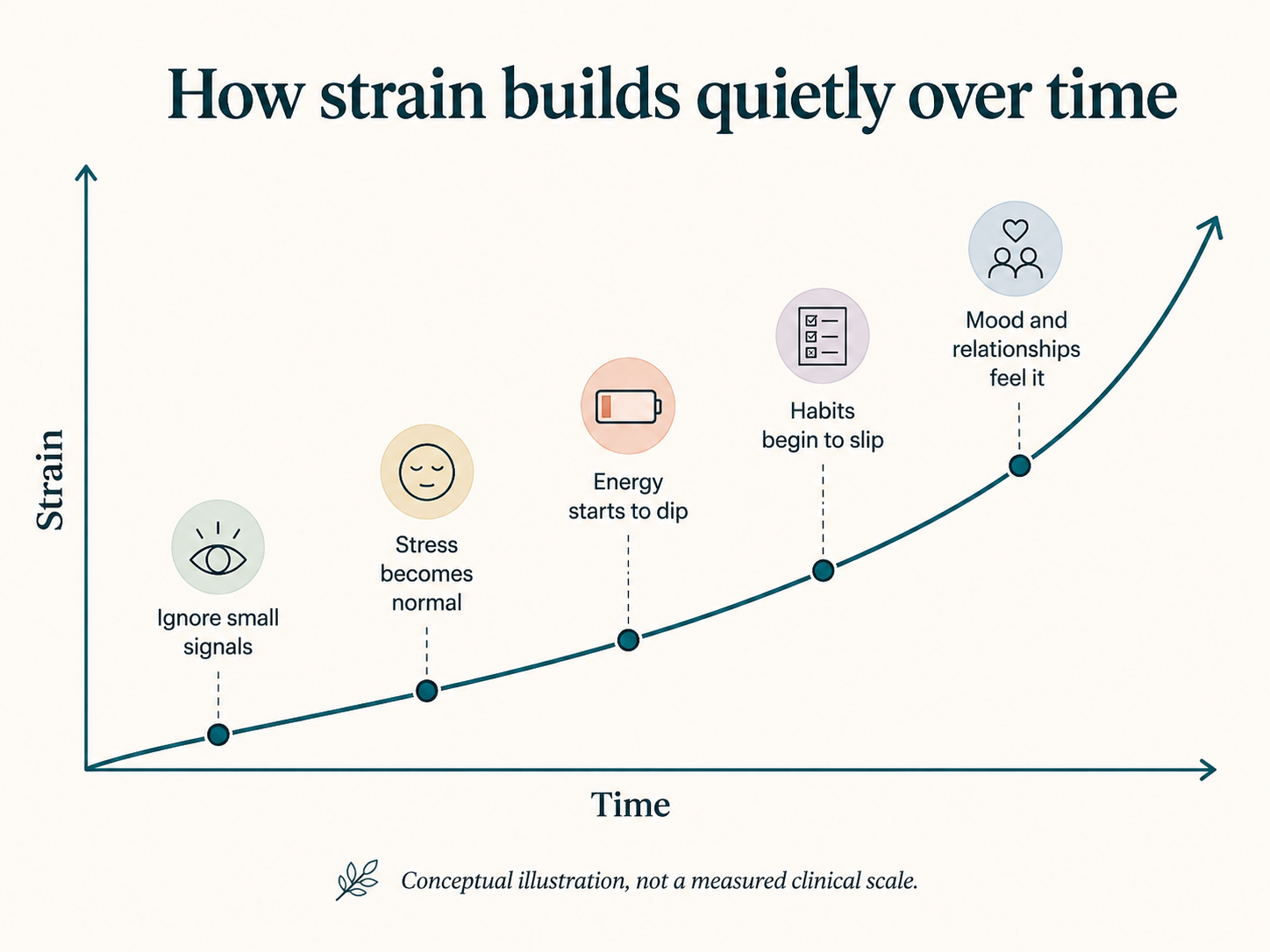
The cost does not usually arrive as a dramatic event. It looks more like a small separation from your own experience.
You wake up and, instead of noticing how rested you feel, you check the sleep score.
You finish the day and, instead of asking whether it contained enough movement, rest or connection, you look at what the dashboard says.
The data may be useful. But if it becomes the only language we trust, something important is lost.
What we actually care about is rarely the number
Nobody really wants a good sleep score.
They want to wake up with enough energy to meet the day.
Nobody deeply cares about completing a ring.
They want a body that still feels capable.
Most people do not meditate because they hope to accumulate an impressive number of meditation minutes. They want some quiet. Some clarity. A little less noise inside their own head.
The things we care about are remarkably ordinary.
Enough energy to enjoy dinner rather than simply reach it.
Enough patience to listen when someone we love is speaking.
Enough presence to notice a good afternoon while it is happening.
Enough steadiness to make a difficult decision without everything else in life collapsing around it.
Enough connection that wellbeing does not become a private project carried out alone.
When we remember this, the question changes.
Instead of asking, "How can I optimise myself better?"
we can ask:
"What is asking for my attention?"
That is a much harder question for an app built around a single metric.
It requires context.
It requires looking across life rather than further into one number.
Perhaps the first step is not more tracking
This is the point at which another approach becomes useful.
Not because trackers should disappear. They can still be helpful. But sometimes the next thing a person needs is not another data point. It is a clearer picture.
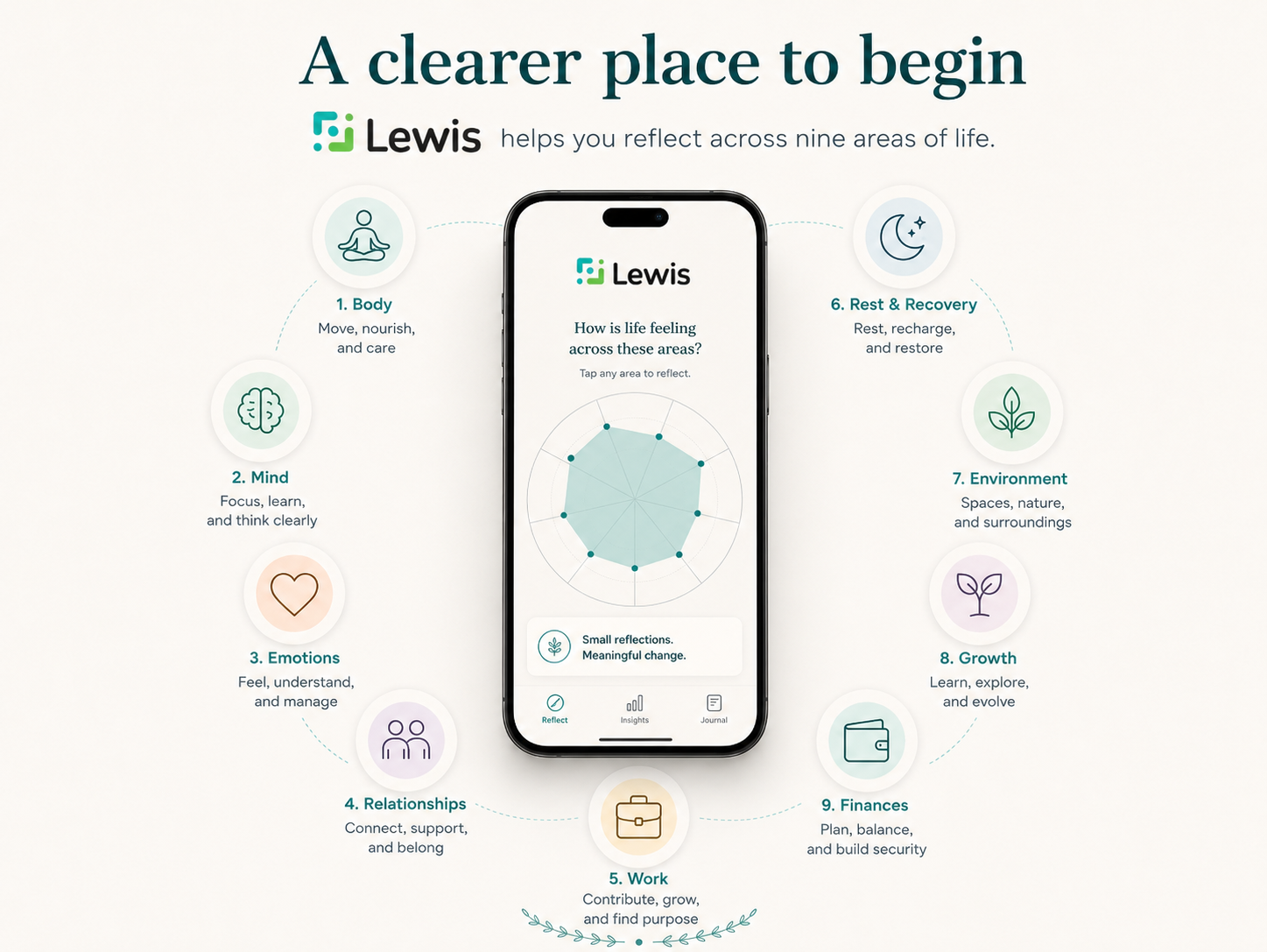
That is what LEWIS is designed to help with.
LEWIS is a guided wellbeing reflection across nine areas of life. Rather than asking you to optimise one behaviour at a time, it helps you look across the wider picture of how life currently feels: where you seem well supported, where you may be running low and how different parts of your wellbeing may be moving together. The reflection leads to a personalised insight report with practical observations and meaningful next steps.
It is not a diagnosis.
It does not tell you whether you are healthy or unhealthy.
It is not another score that needs to be improved.
The purpose is much simpler: to help you notice.
Perhaps you arrive thinking you need better sleep and recognise how much of your mental space work has been taking.
Perhaps you think you lack discipline and realise that you have been asking more from yourself while giving yourself very little recovery.
Perhaps the part of life you assumed was the problem is actually coping reasonably well, while something quieter has been asking for attention.
There is something reassuring about this kind of reflection because it does not assume that every part of life needs fixing. A human life will rarely be perfectly balanced. Some seasons demand more work. Some contain less energy. Some relationships require more of us. Sometimes the goal is not balance at all.
The value is in seeing where you are clearly enough to choose deliberately what comes next.
And that may be the better relationship between technology and wellbeing.
A tool can remind us.
A tracker can show us a pattern.
A number can make something visible.
But none of these has to become the final authority on how our life feels.
There is still something important about being able to notice yourself without first opening a dashboard.
To ask whether you are rested before seeing the score.
To notice that you miss moving before an alert tells you to stand.
To recognise that a week has felt crowded before the consequences become measurable.
To understand that wellbeing is not a performance we complete.
It is the condition in which the rest of our life is being lived.
Perhaps that is where a better starting point begins.
Not with one more thing to optimise.
With a clearer look at the whole.
Begin with LEWIS
Take a guided reflection across nine areas of life and see what may deserve your attention now.


Comments (0)
Be the first to respond. Comments are read by the LIFED team.